Modern businesses collect information from many different sources, including websites, CRM systems, ecommerce platforms, customer forms, advertising tools, social media, and third-party databases. As a result, the same brand can appear in several different formats. For example, a database may contain “Apple,” “Apple Inc.,” “APPLE INC,” and “Apple Incorporated,” even though these entries may represent the same organization.
This inconsistency can create serious data-management problems. Duplicate brand records can affect reporting, customer segmentation, analytics, sales operations, product catalogues, and marketing campaigns. Brand Name Normalization Rules provide a structured way to identify these variations and organize them under a consistent brand identity.
In this guide, we will explore what brand name normalization means, why it is important, the most useful normalization rules, how artificial intelligence can improve the process, and how standardized brand data can support email marketing. We will also look at common mistakes and practical best practices that businesses can use to maintain cleaner and more reliable data.
What Is Brand Name Normalization?
Brand name normalization is the process of identifying different versions of a brand name and converting them into a consistent format. The purpose is to make data easier to search, analyze, compare, and manage across different systems.
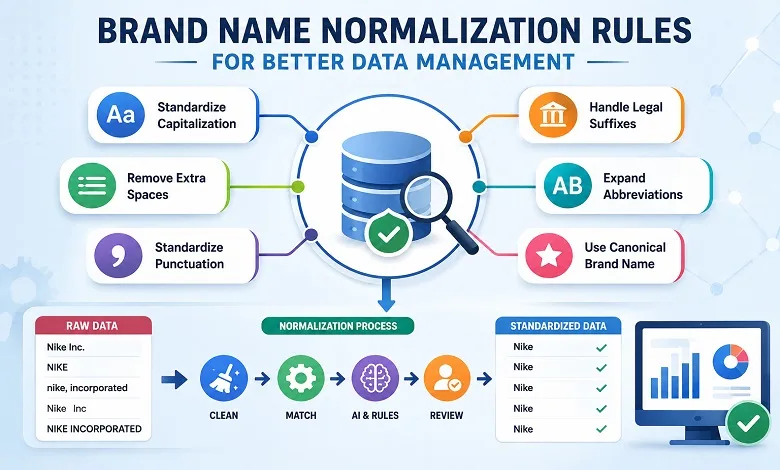
For example, a company may receive the following values from different data sources:
- Nike
- NIKE
- Nike Inc.
- Nike, Inc.
- Nike Incorporated
To a person, these names may obviously refer to the same brand. However, a computer system may treat them as separate values unless specific matching and normalization rules are applied.
A normalization system can map these variations to a preferred value such as Nike. The original value should normally remain available in the database because it can be useful for auditing, historical analysis, or checking how the data was originally collected.
This means normalization does not simply mean deleting information. Instead, it creates a standardized layer that allows businesses to work with consistent brand data while preserving the source information.
Why Are Brand Name Normalization Rules Important?
Inconsistent brand names can create problems throughout an organization. When the same company is recorded under several names, reports may show incorrect totals, customer databases may contain duplicate accounts, and marketing teams may struggle to create accurate audience segments.
For example, imagine a business has customer records containing “Microsoft,” “Microsoft Corp,” and “Microsoft Corporation.” If the database does not recognize these as related values, the organization may see three separate customer groups instead of one combined brand relationship.
Effective Brand Name Normalization Rules help solve this problem by establishing a common structure for brand information. Once the variations are identified and standardized, businesses can use the cleaned data with greater confidence.
Brand normalization can improve several areas, including:
- Customer relationship management
- Sales reporting
- Product catalogue management
- Business intelligence
- Marketing analytics
- Customer segmentation
- Search and filtering
- Email marketing
- Data integration
- Duplicate record detection
The value becomes even greater when a company manages millions of records from multiple sources.
Common Brand Name Normalization Rules
There is no single normalization formula that works for every organization. Different industries have different requirements, and some businesses need to preserve legal company names while others are more interested in consumer-facing brand names.
However, several rules can provide a strong foundation for most normalization systems.
1. Standardize Capitalization
Capitalization is one of the most common causes of duplicate brand values. The same name can be entered in uppercase, lowercase, title case, or a mixture of different styles.
For example, a database might contain “amazon,” “AMAZON,” “Amazon,” and “AmaZon.” A normalization process can convert these values into a consistent format for matching and reporting.
However, businesses should distinguish between the internal normalized value and the official presentation of a brand. Some companies intentionally use unusual capitalization in their official branding, so the normalized value should not automatically replace the brand’s preferred public presentation.
2. Remove Unnecessary Spaces
Extra spaces are another common source of data inconsistency. Users may accidentally add spaces before or after a brand name, or a data-import process may introduce multiple spaces between words.
A normalization rule can remove unnecessary leading and trailing spaces and convert repeated internal spaces into a single space. This simple process can eliminate a significant number of accidental duplicates.
3. Standardize Punctuation
Punctuation can also create variations of the same brand. Hyphens, commas, periods, apostrophes, and other characters may appear differently depending on the source.
For example, a database could contain “Coca-Cola,” “Coca Cola,” and “Coca–Cola.” Depending on the purpose of the database, the system may preserve the official punctuation while ignoring punctuation differences during the matching process.
The important point is to define the rule clearly before applying it. Removing every punctuation mark is not always appropriate because punctuation can sometimes be an important part of an official brand identity.
4. Handle Legal Business Suffixes
Business names frequently contain legal suffixes such as “Inc.,” “LLC,” “Ltd.,” “Limited,” “Corporation,” “Corp.,” and “PLC.” These suffixes can create multiple variations of what is essentially the same organization.
For example, “Adobe Inc.” and “Adobe Incorporated” may need to be recognized as the same business for marketing and analytics purposes.
A company can create rules that ignore these suffixes during matching while keeping the original legal name in a separate field. This approach provides flexibility because businesses can use the standardized brand name for reporting without losing the legal information.
5. Standardize Common Abbreviations
Abbreviations can make brand matching more complicated. A company might appear under its full name in one database and a short version or acronym in another.
Examples include “IBM” and “International Business Machines” or “P&G” and “Procter & Gamble.” If these relationships are known and verified, a brand normalization dictionary can map the variations to a preferred name.
However, automatic abbreviation expansion should be used carefully. The same abbreviation may represent different companies in different industries or geographic markets, so additional information may be required before confirming a match.
6. Create a Canonical Brand Name
A canonical brand name is the preferred standardized value that represents all recognized variations of a particular brand.
For example:
| Original Brand Name | Normalized Brand Name |
| Apple Inc. | Apple |
| APPLE | Apple |
| Apple Incorporated | Apple |
| Apple, Inc. | Apple |
| apple | Apple |
The canonical value becomes the standard reference used in reports, filters, dashboards, segmentation systems, and other business applications.
Keeping a canonical field separate from the original field is usually a better approach than replacing the source data.
Exact Matching and Fuzzy Matching
One of the biggest challenges in brand normalization is determining whether two different names actually represent the same organization.
Exact Matching
Exact matching works well when the differences between names are predictable. For example, “NIKE INC.” and “Nike Inc.” can become identical after capitalization and punctuation rules are applied.
This approach is fast, easy to understand, and highly predictable. It works particularly well when the source data is relatively clean.
Fuzzy Matching
Fuzzy matching is useful when brand names contain spelling differences, missing words, abbreviations, or other variations that cannot be solved through simple formatting rules.
For example, “International Business Machines Corporation” and “International Business Machines Corp” are not identical strings, but they may have a very high level of similarity.
Fuzzy matching should be used carefully because similar names do not always represent the same company. Additional information such as website domains, addresses, industry, country, product categories, and corporate identifiers can improve the accuracy of the matching process.
Building a Brand Normalization Dictionary
A brand normalization dictionary is one of the most useful tools for maintaining standardized data. It contains known brand variations and connects them to a preferred canonical name.
A basic dictionary might include the original value, normalized value, and confidence level. For example, “Coca Cola,” “COCA COLA,” and “Coca Cola Co.” could all be mapped to “Coca-Cola” when the relationship has been verified.
The dictionary should be maintained over time because new variations will continue to appear. When a data-management team manually approves a new variation, that decision can be added to the dictionary so that future records can be processed automatically.
This creates a continuously improving normalization system rather than a one-time data-cleaning project.
Brand Name Normalization Rules AI
Artificial intelligence can make brand normalization more effective when businesses work with large and complicated datasets. Brand name normalization rules AI refers to the use of artificial intelligence, machine learning, natural language processing, and intelligent matching techniques to identify possible relationships between different brand names.
Traditional rules are excellent for predictable transformations such as capitalization, spaces, punctuation, and known abbreviations. AI becomes more useful when a system needs to interpret context and identify less obvious relationships.
For example, an AI-powered system can compare brand names while considering information from other fields. Instead of looking only at the text of the company name, it may consider a website domain, industry, location, product information, or other available attributes.
How AI Can Help with Brand Normalization
AI can support a normalization workflow in several ways. It can identify unusual spelling variations, detect potential duplicate brands, rank possible matches, and assign confidence scores to uncertain results.
AI can also learn from previously reviewed records. If a data-management team repeatedly confirms certain variations as belonging to the same brand, those decisions can help improve future matching.
However, AI should not be treated as an infallible decision-maker. Incorrect matches can be just as damaging as duplicate records, particularly when the data is used for financial reporting, customer management, or legal purposes.
Why a Hybrid Normalization Approach Works Better
For many organizations, the best approach is a combination of traditional rules, reference dictionaries, fuzzy matching, AI, and human review.
A practical workflow can begin by cleaning obvious formatting issues such as unnecessary spaces and inconsistent capitalization. The system can then check the brand dictionary and apply exact matches before using fuzzy or AI-based methods for records that remain unresolved.
Low-confidence matches can be sent to a human reviewer. Once the reviewer approves or rejects a match, the decision can be stored and reused in future normalization tasks.
This hybrid approach provides the efficiency of automation while maintaining greater control over important decisions.
Brand Name Normalization Rules for Email Marketing
Brand normalization is particularly useful for marketing teams that rely on customer and company data. The connection between brand name normalization rules email marketing becomes clear when marketers use brand information for segmentation, personalization, account-based marketing, and campaign reporting.
Suppose an email database contains “Nike,” “NIKE Inc.,” “Nike Corporation,” and “Nike Inc.” as separate company values. A marketing platform may interpret these as different groups and produce fragmented campaign segments.
After normalization, the records can be connected to a single standardized brand. This makes it easier for marketers to understand the audience and create more accurate campaigns.
Better Audience Segmentation
Normalized brand information allows marketing teams to create cleaner segments. Instead of maintaining several lists for different versions of the same company, marketers can use a single standardized brand value.
This is particularly useful for account-based marketing, where sales and marketing teams need an accurate understanding of all contacts associated with a target organization.
More Consistent Personalization
Personalized email campaigns often use company names in subject lines, introductions, or other content. Inconsistent information can make messages look unprofessional or confusing.
A standardized brand field gives the marketing platform a reliable value to use when creating personalized campaigns.
More Accurate Campaign Reporting
Normalization can also improve marketing analytics. If contacts belonging to one company are divided between multiple brand-name variations, engagement data may be scattered across several records.
Standardized data makes it easier to measure campaign performance and understand how different organizations interact with marketing content.
Brand Normalization in CRM Systems
Customer relationship management systems depend on accurate company and account information. Duplicate or inconsistent brand names can cause sales teams to create multiple accounts for the same organization or misunderstand the total value of an account.
A normalized brand field can support account matching, lead management, customer segmentation, sales reporting, and account-based marketing.
For example, if a sales team receives leads from several different sources, each source may provide a slightly different company name. Normalization can help connect those records before they create unnecessary duplicate accounts.
Brand Name Normalization for Product Catalogs
Brand normalization is also valuable for ecommerce companies, retailers, distributors, and businesses that manage large product catalogs.
A product database might contain “Samsung,” “Samsung Electronics,” “SAMSUNG ELECTRONICS CO.,” and “Samsung Electronics Co., Ltd.” If these values are treated as different brands, product filters and reports may become inaccurate.
Standardized brand information can improve product search, category organization, inventory analysis, supplier management, and customer-facing filters.
This is particularly important for large marketplaces where products are imported from many suppliers and manufacturers.
Common Brand Normalization Mistakes
Although normalization improves data quality, poorly designed rules can create new problems. One common mistake is over-normalization, where too much information is removed and different organizations are incorrectly treated as the same brand.
Another problem is relying entirely on name similarity. Two businesses can have very similar names without having any relationship with each other. Matching should therefore consider context and additional identifiers whenever possible.
Businesses should also avoid deleting the original brand name. Keeping the source value makes it possible to audit normalization decisions and correct mistakes later.
Finally, organizations should not automatically approve every AI-generated match. Low-confidence results should be reviewed before they become part of the trusted dataset.
Best Practices for Brand Name Normalization
A successful normalization strategy should be consistent, transparent, and easy to maintain. Businesses should begin by defining exactly what they want the normalized brand field to represent and whether the purpose is marketing, legal reporting, product management, customer analytics, or another business function.
The following practices can help:
- Preserve the original brand name in a separate field.
- Create a standardized canonical brand field.
- Document every normalization rule.
- Maintain a centralized brand dictionary.
- Standardize capitalization and whitespace.
- Handle punctuation consistently.
- Create verified mappings for common abbreviations.
- Use exact matching whenever possible.
- Apply fuzzy matching carefully.
- Use AI for complex or ambiguous cases.
- Add confidence scores to uncertain matches.
- Review important low-confidence records manually.
- Test rules before applying them to production data.
- Monitor new variations regularly.
- Update the normalization dictionary as new cases appear.
These practices make the normalization process easier to manage and reduce the risk of incorrect brand associations.
How to Measure the Success of Brand Normalization
A normalization system should be measured after implementation to determine whether it is actually improving data quality.
Useful metrics include the number of duplicate brand records before and after normalization, the percentage of records successfully matched, the number of unresolved names, and the rate of incorrect matches.
Businesses can also measure improvements in CRM duplicate accounts, search accuracy, marketing segmentation, and reporting consistency.
Regular monitoring is important because data changes continuously. New brands, acquisitions, abbreviations, spelling variations, and source systems can introduce new inconsistencies over time.
The Future of Brand Name Normalization
As businesses continue to collect information from more digital sources, brand normalization will become an increasingly important part of data management. Companies cannot rely on manual cleanup when they are processing thousands or millions of records.
AI and machine learning will likely play a larger role in identifying complex relationships between brand names. However, traditional rules, verified dictionaries, and human review will remain important because businesses need predictable and explainable data-management processes.
The most effective systems will combine automation with strong data governance. This will allow organizations to process large datasets efficiently while maintaining a high level of accuracy.
Conclusion
Brand Name Normalization Rules are an important part of modern data management. They help businesses identify different versions of the same brand and organize those records under a consistent structure. By standardizing capitalization, spaces, punctuation, abbreviations, legal suffixes, and known variations, companies can reduce duplicate data and improve the quality of their business information.
The use of brand name normalization rules AI can make the process even more powerful by helping organizations identify complex matches and process large datasets. However, AI works best when it is combined with deterministic rules, trusted reference data, confidence scoring, and human review.
The benefits also extend to marketing. Applying brand name normalization rules email marketing workflows can improve audience segmentation, personalization, and campaign reporting while helping teams maintain a more accurate view of their customers.
Ultimately, effective brand normalization is not simply about making names look the same. It is about creating reliable relationships between data records while preserving the original information. With a well-designed normalization strategy, businesses can build cleaner databases, improve analytics, reduce duplication, and make better decisions based on trustworthy data.

One thought on “Brand Name Normalization Rules for Better Data Management”
Comments are closed.