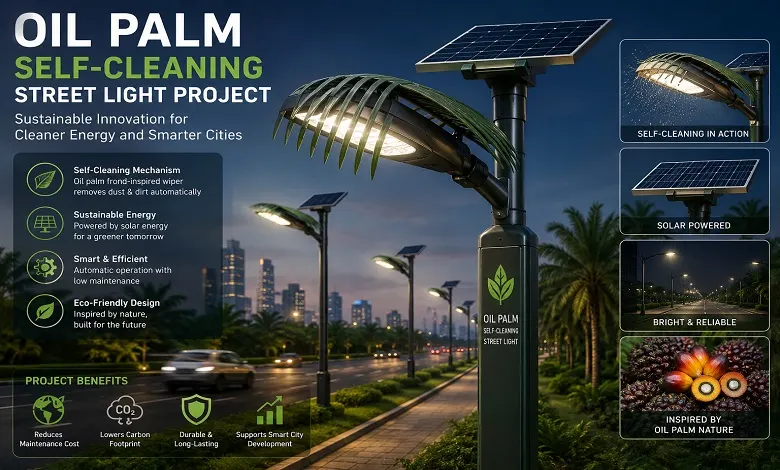
Lighting roads and work areas in oil palm plantations can be challenging. Many plantation routes are located away from urban infrastructure, while dust, humidity, vegetation, and industrial residues can create additional maintenance problems for outdoor lighting systems. The oil palm self-cleaning street light project offers an interesting approach to this challenge by combining solar-powered LED lighting with automated cleaning technology. Instead of depending entirely on grid electricity or frequent manual maintenance, the system is designed to generate its own power and help keep the solar panels operating effectively.
The concept is particularly relevant to oil palm-producing regions, where plantation roads, processing areas, worker communities, and rural routes may require dependable lighting after dark.
Understanding the Oil Palm Self-Cleaning Street Light Project
An oil palm self-cleaning street light project combines three important ideas: solar energy, automated maintenance, and plantation-focused infrastructure.
A conventional solar street light uses a photovoltaic panel to collect sunlight during the day, stores the energy in a battery, and uses it to power an LED lamp at night.
The challenge is that solar panels work best when their surfaces receive adequate sunlight. Dust and other deposits can accumulate over time, potentially reducing the amount of sunlight reaching the photovoltaic cells.
A self-cleaning system addresses this maintenance challenge by incorporating a mechanism that automatically cleans the solar panel at scheduled intervals or as required by the system.
In a palm-growing environment, this can be particularly useful because lighting infrastructure may be installed along long plantation roads where frequent manual cleaning is inconvenient.
Why Palm Oil Plantation Areas Need Specialized Lighting
Oil palm plantations can cover large areas, with roads connecting fields, processing facilities, storage areas, worker accommodation, and access points.
These roads may need lighting for several reasons, including:
- Safer movement after sunset
- Plantation access
- Worker transportation
- Security
- Nighttime logistics
- Facility access
- Visibility around processing areas
Installing conventional grid-connected street lights in remote plantation areas can require extensive electrical infrastructure.
Solar street lighting provides another option because each lighting unit can generate and store its own electricity.
The concept becomes even more attractive when the lighting system is designed for lower maintenance.
The Role of Self-Cleaning Technology
The key feature of a self-cleaning solar street light is its ability to reduce the need for frequent manual cleaning of the photovoltaic panel.
A typical solar street light depends on sunlight to recharge its battery. When dust or other material accumulates on the panel, energy collection can be affected.
A self-cleaning mechanism can periodically move across the panel surface and remove accumulated particles.
Depending on the design, cleaning may involve:
- Automated brushes
- Wiping mechanisms
- Robotic arms
- Specialized surface coatings
- Other automated cleaning technologies
The specific technology should be selected according to the local environment, panel design, maintenance requirements, and available energy.
In the Bosun case study associated with the palm-belt project, the proposed system included automated photovoltaic cleaning using robotic arms, with the cleaning cycle designed to operate twice a day.
How a Self-Cleaning Solar Street Light Works
The basic operating process is straightforward.
1. Solar Energy Collection
During daylight, the photovoltaic panel captures solar radiation and converts it into electrical energy.
2. Battery Charging
The generated electricity is regulated and stored in a rechargeable battery.
Modern solar street lights commonly use lithium-based battery technologies because they can provide useful energy-storage performance within a relatively compact system.
3. Automatic Lighting
When daylight decreases, a controller activates the LED lamp.
The battery then supplies electricity to the lighting system during the night.
4. Automated Panel Cleaning
At a predetermined time or according to programmed conditions, the cleaning mechanism moves across the solar panel and removes accumulated dust or debris.
5. Monitoring and Control
More advanced systems can incorporate remote monitoring.
In the Bosun project description, IoT-based monitoring was included to support remote diagnostics and adjustment of the cleaning cycle.
This type of monitoring can be useful when lighting installations are spread across large plantation areas.
The Self-Cleaning Street Light Palm Oil Connection
The phrase self cleaning street light palm oil project describes the connection between self-cleaning solar lighting technology and the infrastructure requirements of palm oil-producing regions.
The important point is that the lighting system does not necessarily have to be powered by palm oil or palm waste.
Instead, the connection can be geographical and operational: solar street lights are deployed in areas where oil palm plantations and processing activities create a need for reliable outdoor lighting.
This distinction is important when describing the project accurately.
The system can therefore be understood as a solar lighting solution adapted to the environmental and operational conditions of palm oil plantation areas.
A Case Study from Nigeria’s Palm Belt
Port Harcourt, Nigeria, provides an example of how this concept can be applied to an oil palm environment.
According to the Bosun case study, the project focused on plantation roads in the region and considered environmental conditions including humidity, dust, and residues associated with palm-oil processing. The proposed deployment covered internal plantation roads and incorporated self-cleaning solar street lights.
The engineering assessment described a plantation-road network requiring lighting along approximately 9 km of internal roads. The proposed design included 6.5-meter poles with approximately 40-meter spacing, alongside solar panels, batteries, LED lighting, and an automated cleaning system.
The project demonstrates how solar street lighting can be adapted to the specific requirements of agricultural and plantation infrastructure.
Why Self-Cleaning Matters in Plantation Environments
Maintenance can become one of the biggest challenges when solar street lights are installed in remote areas.
A technician may need to travel considerable distances to reach individual lighting units. If the installation contains dozens or hundreds of lights, routine cleaning can become a significant operational task.
Self-cleaning technology can help reduce this burden.
Instead of requiring workers to manually access every solar panel, an automated system can perform regular cleaning cycles.
This can potentially provide several advantages:
- Less frequent manual cleaning
- Reduced maintenance visits
- Easier management of remote installations
- More consistent panel cleanliness
- Lower routine maintenance requirements
- Better visibility into system performance
However, self-cleaning does not mean maintenance-free. Motors, moving parts, batteries, controllers, mounting structures, and electrical connections still require periodic inspection.
Main Components of the Project
A modern oil palm self-cleaning street light system can include several interconnected components.
Solar Panel
The photovoltaic panel is responsible for converting sunlight into electrical energy.
Its size should be selected according to the lighting load, battery capacity, local solar conditions, expected operating hours, and system efficiency.
LED Street Light
LED technology provides the illumination required for plantation roads and other outdoor areas.
The required wattage depends on road width, pole height, spacing, lighting standards, and desired illumination levels.
Rechargeable Battery
The battery stores solar energy during the day so that the LED can operate after sunset.
Battery capacity should be calculated based on expected nighttime operation and the required autonomy during periods of poor weather.
Solar Controller
The controller manages energy flow between the solar panel and battery and helps protect the energy-storage system.
Cleaning Mechanism
This is the defining feature of the project.
A motorized mechanism can move a brush, wiper, or robotic arm across the panel surface to remove accumulated material.
Controller
A programmable controller can coordinate lighting, cleaning, battery management, and sensor inputs.
IoT Monitoring
Advanced installations can use connected monitoring systems to provide information about:
- Battery status
- Solar generation
- Lighting operation
- Cleaning cycles
- Equipment faults
- System performance
Remote monitoring can be especially valuable when lights are installed across large plantation areas.
Environmental Conditions and System Design
A successful plantation lighting project should begin with an environmental assessment.
Important factors include:
Solar Radiation
The available solar resource affects the size of the photovoltaic system and battery.
Humidity
High humidity can affect electrical equipment and mechanical components if they are not adequately protected.
Dust
Dust accumulation is particularly relevant to solar panels because it can affect sunlight transmission.
Oil and Industrial Residues
Areas near palm-oil processing facilities may have environmental conditions that differ from ordinary rural roads.
Equipment coatings, seals, and protective enclosures should therefore be selected according to the actual installation environment.
Wind and Rain
Pole design, panel mounting, and electrical enclosures need to account for local weather conditions.
Engineering Assessment Before Installation
A successful oil palm self-cleaning street light project requires more than selecting a solar lamp.
Engineers should assess the entire installation.
Solar Resource Assessment
The solar resource should be evaluated before determining panel capacity and battery requirements.
Road Survey
The road layout should be mapped to determine pole positions, spacing, mounting height, and lighting coverage.
Lighting Requirements
The required illumination level should be determined according to the type of road and its intended use.
Battery Sizing
Battery capacity should account for nighttime energy consumption and periods of reduced solar generation.
Cleaning Requirements
The cleaning frequency should reflect actual environmental conditions.
Cleaning too frequently can consume unnecessary energy, while cleaning too rarely may allow deposits to accumulate.
Structural Design
Poles and mounting systems need to withstand local environmental conditions, including wind and rain.
Benefits of the Project
Renewable Energy-Based Lighting
Solar power allows individual lighting units to operate without requiring a conventional grid connection at every location.
Reduced Manual Cleaning
Automated panel cleaning can reduce the need for workers to manually clean solar panels.
Improved Remote Management
IoT monitoring can help operators identify equipment problems without physically visiting every installation.
Better Plantation Accessibility
Adequate lighting can improve visibility along internal roads and access routes during nighttime operations.
Potentially Lower Maintenance Costs
Reducing unnecessary maintenance trips can be valuable when lighting infrastructure is distributed across a large area.
Sustainable Infrastructure
Solar-powered LED lighting provides an alternative to lighting systems that depend entirely on grid electricity or fossil-fuel generators.
Applications Beyond Oil Palm Plantations
Although the project is particularly relevant to palm oil regions, the underlying technology has broader applications.
Self-cleaning solar street lights can potentially be considered for:
- Rural roads
- Agricultural estates
- Industrial facilities
- Mining areas
- Remote communities
- Warehouses
- Logistics facilities
- Resorts
- Campuses
- Parks
- Construction sites
- Off-grid infrastructure
The technology becomes especially interesting where solar panels are exposed to significant dust and where manual maintenance is difficult.
Solar Street Light vs. Self-Cleaning Solar Street Light
A conventional solar street light and a self-cleaning solar street light use the same fundamental energy concept, but their maintenance strategies differ.
A standard system generally requires periodic manual inspection and cleaning.
A self-cleaning system adds an automated mechanism designed to reduce the need for manual panel cleaning.
The latter can therefore be more suitable for locations where:
- Solar panels become dirty quickly
- Installation areas are difficult to access
- Maintenance travel is expensive
- Large numbers of lights are deployed
- Consistent solar collection is important
However, the additional mechanical components increase system complexity and cost.
The right choice depends on the environment and lifecycle requirements rather than simply choosing the most technologically advanced system.
Challenges to Consider
Self-cleaning solar street lights are not a universal solution.
Higher Initial Complexity
A cleaning mechanism requires motors, mechanical components, controllers, and additional engineering.
Moving Parts Require Maintenance
Although the system reduces manual panel cleaning, the cleaning mechanism itself needs inspection.
Energy Consumption
The cleaning mechanism consumes some energy. The system should be designed so that cleaning does not unnecessarily reduce the energy available for lighting.
Harsh Outdoor Conditions
Rain, humidity, dust, insects, and temperature changes can affect mechanical and electronic components.
Initial Investment
A more sophisticated system may cost more initially than a basic solar street light.
A proper lifecycle-cost analysis should compare the additional investment against expected maintenance savings.
Making the Project More Efficient
Several design strategies can improve overall system performance.
Use Smart Cleaning Schedules
Instead of cleaning continuously, the system can operate according to predefined schedules or sensor-based conditions.
Monitor Solar Output
Monitoring changes in panel performance can help determine whether cleaning is necessary.
Use Efficient Motors
The cleaning actuator should consume as little energy as possible while providing sufficient mechanical force.
Protect Electronic Components
Weather-resistant enclosures and appropriate electrical protection can improve reliability.
Plan Preventive Maintenance
Even automated systems require periodic inspection. Preventive maintenance can identify mechanical wear, battery degradation, loose connections, and other issues before they cause failures.
Future Potential of Self-Cleaning Solar Lighting
The future of the technology lies in combining automated cleaning with intelligent monitoring.
Instead of cleaning at fixed intervals, future systems could use sensors and performance data to determine when a panel actually needs attention.
A smart system could monitor:
- Solar panel output
- Battery voltage
- Charging current
- Cleaning frequency
- Motor condition
- Lighting status
- Environmental conditions
IoT connectivity could then provide remote alerts when a system requires human intervention.
This approach could make large plantation lighting networks easier to manage because operators would have visibility into system conditions without physically inspecting every light.
Conclusion
The oil palm self-cleaning street light project represents a practical combination of renewable energy, LED lighting, automated maintenance, and smart monitoring for plantation environments.
Its significance lies not in using palm oil as the energy source, but in adapting solar street-lighting technology to the particular challenges of oil palm regions. Plantation roads can be remote, difficult to maintain, and exposed to dust, humidity, and other environmental factors. A self-cleaning mechanism can help address one of the ongoing maintenance challenges associated with solar panels.
The Nigerian palm-belt case study demonstrates how such a system can be planned around real plantation-road requirements, including pole height, road coverage, solar generation, battery storage, automated cleaning, and remote monitoring.
As solar technology, batteries, sensors, and IoT systems continue to improve, self-cleaning solar street lights could become increasingly useful for remote agricultural and industrial infrastructure. The most successful projects, however, will be those designed around actual local conditions, realistic maintenance requirements, appropriate lighting standards, and long-term lifecycle costs.
FAQs:
A. An oil palm self-cleaning street light project combines solar-powered LED lighting with an automated solar-panel cleaning system for oil palm plantations, rural roads, and similar environments.
A. The solar panel collects energy during the day, while an automated cleaning mechanism periodically removes dust and debris from its surface. Stored energy powers the LED light at night.
A. A self-cleaning street light palm oil project aims to provide reliable lighting in palm-growing areas while reducing the need for frequent manual solar-panel cleaning and maintenance.
A. Typical components include a solar panel, LED lamp, rechargeable battery, charge controller, lighting controller, pole, and automated panel-cleaning mechanism.
A. They can be used along plantation roads, agricultural estates, rural routes, processing facilities, worker areas, and other locations where reliable off-grid lighting is required.
